Easmond Tsewole
Chief Executive Officer

Your SOC 2 report describes your infrastructure on the day the auditor looked at it. Configuration drift is what happens every day after that.
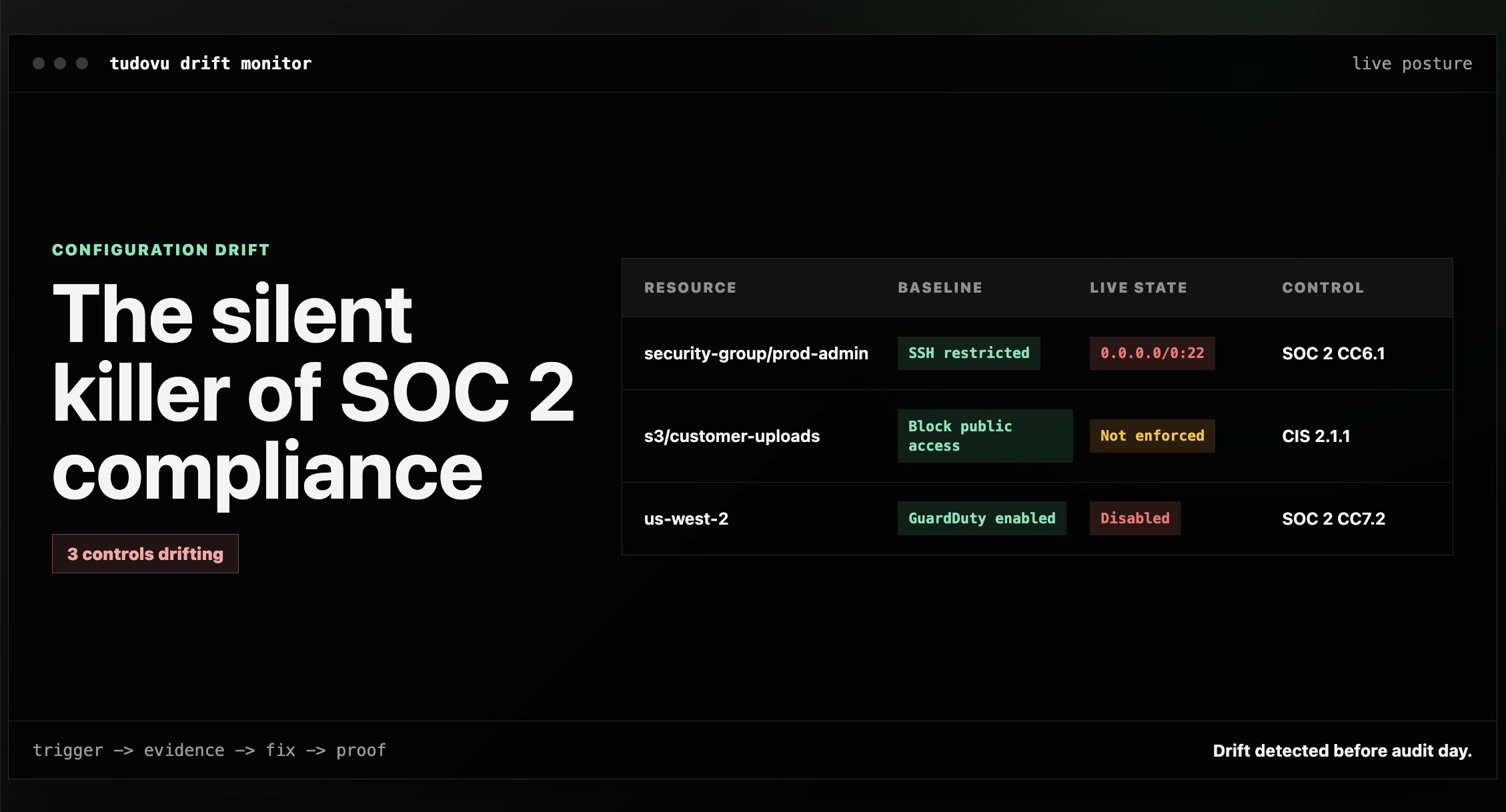
A SOC 2 report is a photograph. Your AWS account is a live system. The moment the auditor signs off, the two start diverging, and the gap between them has a name: configuration drift.
Most teams don't notice it until it costs them something, such as a failed check that sat open for a quarter, a stalled enterprise deal, an exception letter in the Type II report. This post is about why drift is specifically lethal for SOC 2, and what it takes to keep it at zero.
Configuration drift is the difference between the infrastructure you declared, the CloudFormation templates, the security baselines, the settings your auditor reviewed, and what is actually running in your account right now.
Every one of these is defensible in the moment. None of them went through the change process your auditor reviewed. That's drift in one sentence: infrastructure changes that bypass your own controls.
A Type I report is a point-in-time snapshot. It says your controls were designed properly on the day of review.
A Type II makes a much bigger claim: that your controls operated across the entire observation window, typically six to twelve months. That changes what drift means. A drifted configuration isn't housekeeping you'll get to later. It's evidence that a control stopped operating inside the window your auditor is attesting to. Encryption that was on in December and off in March is a Type II problem even if it's back on by audit time.
And audits are moving in exactly the wrong direction for teams that drift. Screenshot evidence is giving way to continuous monitoring. A screenshot of your security group rules answers what they looked like on one day. The question auditors increasingly ask is harder: how do you know those rules didn't change on the other 364?
The canonical story is Capital One. In 2019, a misconfigured web application firewall in their AWS environment let an attacker reach data on roughly 100 million customers. In 2020, the OCC fined them $80 million for it. Nobody at Capital One decided to run that configuration. It drifted from intent, and nothing caught it before someone else did.
Most companies never get the headline. They get the quieter version: findings that reopen every scan, a security review that drags a deal out by a quarter, an audit that passes with exceptions a prospect's security team will read closely. And when drift does become a breach, IBM's 2025 Cost of a Data Breach report puts the average at $4.4M globally and over $10M in the US — with misconfigured cloud resources remaining one of the most common ways in.
GRC platforms made detection nearly free. Connect Vanta or Drata to your account and within an hour you have a dashboard of failing checks. That's genuinely useful. It's also where the work starts, not where it ends.
Every finding still walks the same path: triage, ticket, an engineer context-switches off the roadmap, figures out what the fix might break, patches it, screenshots the evidence. RedSecLabs estimates 150–300 engineering hours per audit — with a GRC platform already in place. We lived this ourselves, which is why we built an open-source agent to remediate SOC 2 findings in the first place.
Founders we've interviewed describe the same math: the platform subscription is the cheap part. The engineer-months to actually clear the queue are the real bill.
Here's the uncomfortable part. Detection without remediation doesn't stop drift. It documents it. The dashboard fills continuously, because drift is continuous — and a human clearing tickets between feature work isn't.
The fix isn't another dashboard. It's changing how infrastructure changes.
1. One source of truth. If it isn't in CloudFormation, it doesn't exist. Import the resources someone created in the console, then treat the templates — not the account — as reality. Drift only becomes measurable once there's a declared state to diff against.
2. Every change is a pull request. Reviewable, attributable, revertible. The console goes read-only. This does double duty: it closes the side doors that drift walks through, and your git history quietly becomes the cleanest audit evidence you own — who changed what, when, and who approved it.
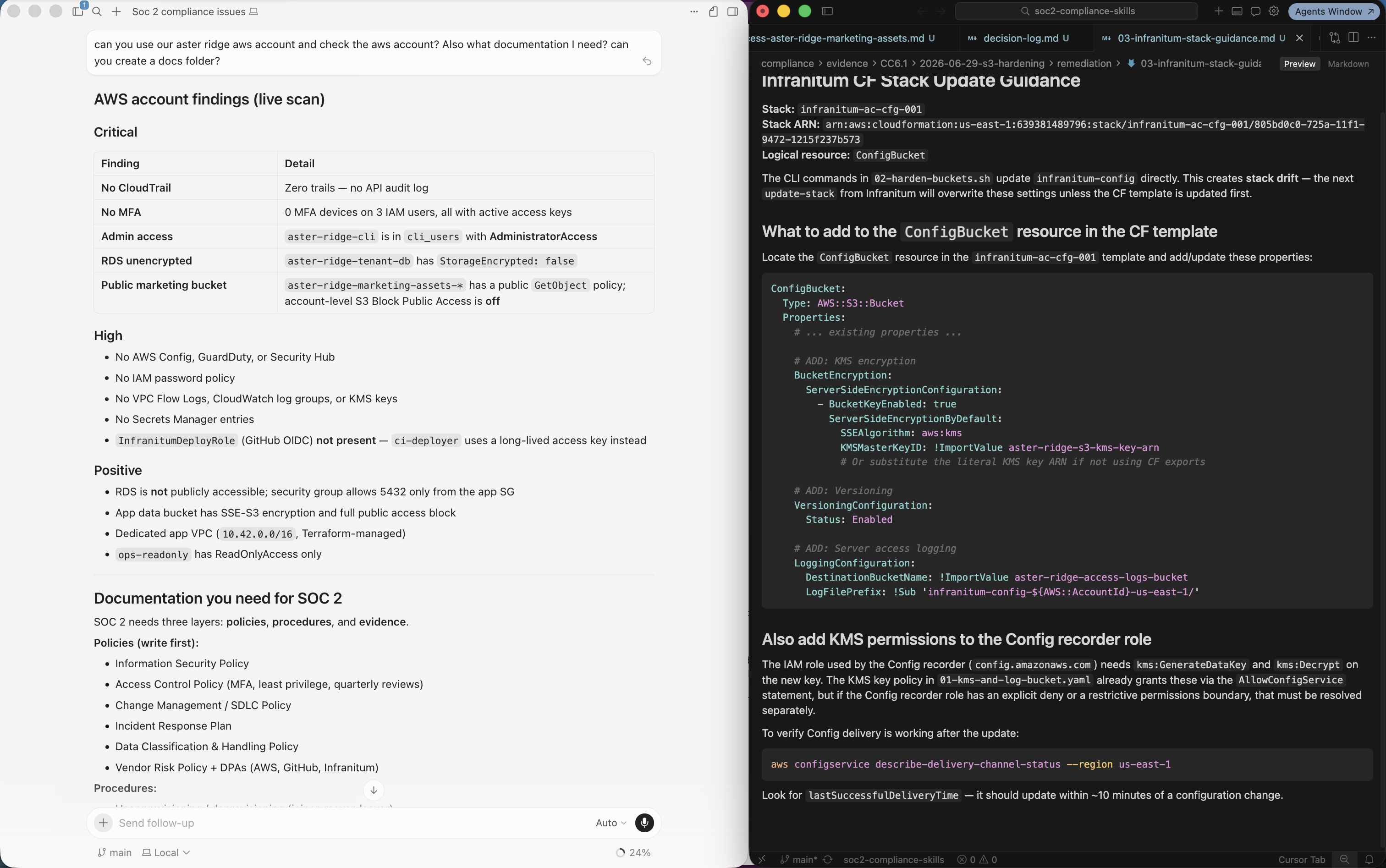
3. Remediate at the speed of drift. Drift never stops, so correction can't either. This is what we've built Tudovu's agents to do: a finding appears — from Security Hub, your GRC platform, or our own framework checks — and an agent verifies it's real, assesses the blast radius so the fix doesn't take down something it shouldn't, drafts the CloudFormation patch, and opens a PR the same day. Your engineer reviews a diff instead of losing an afternoon. Evidence attaches itself.
Do those three things and drift never gets a head start — which means compliance never falls behind.
The teams that stay audit-ready year-round aren't working harder at compliance. They've made drift structurally difficult: one source of truth, changes only through PRs, remediation that runs as continuously as drift does.
That's the platform we're building. If your Type II window is already running — or a prospect just asked for your report — book a demo. Architect, our agent that designs compliant-by-default infrastructure and lands it as reviewable IaC PRs, opens for early access soon — join the waitlist. And the open-source remediation agent that started all this is on GitHub: clone it, hand it your findings, and you'll have your first blast-radius analysis in about five minutes.
Perspective for technical leaders navigating growth and strategy, while being secure & compliance.